

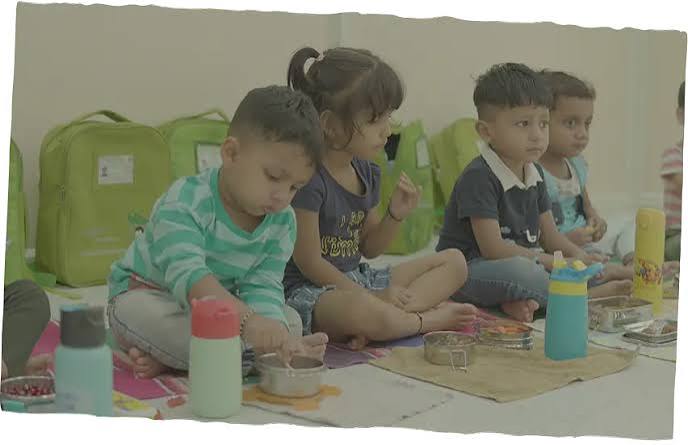
Around the time a child turns two, many Bengaluru parents start hearing the same question at the park, in the society WhatsApp group and from relatives: “Have you put her in playschool yet?” Some toddlers in the building are already carrying tiny backpacks, while others are at home with a grandparent or nanny. If you are wondering whether 2.5 years is the right age, too early, or simply one reasonable option among several, you are not alone.
The honest answer is that there is no single right age that suits every child. Starting at 2.5 works beautifully for some families and is unnecessary, or even stressful, for others. This guide lays out the rules, the benefits, the concerns and the practical Bengaluru-specific factors so you can make the call that fits your child.
Why This Question Comes Up So Often in Bengaluru
Bengaluru has a large population of nuclear, dual-income families, many of whom moved to the city for work and live away from extended family. For these parents, preschool often doubles as a safe, structured place for the child during working hours. Long commutes across areas like Whitefield, Electronic City, Sarjapur Road and Hebbal add to the pressure to find a reliable routine early.
There is also a social element. When neighbours’ children start playgroup at two, parents can feel their own child is “falling behind” by staying home. That feeling is understandable, but it is worth separating peer pressure from what your child actually needs.
What Karnataka’s Age Rules Actually Say
Before deciding, it helps to know how the formal school timeline works in Karnataka:
• LKG: The state’s Department of School Education has set 4 years as the minimum age for LKG admission, with UKG at 5 years.
• Class 1: Children must have completed 6 years by June 1 of the admission year. For the 2026–27 academic year, the government granted a one-time 60-day relaxation, allowing children aged 5 years and 10 months to enrol.
• Playgroup and pre-nursery: The stages before LKG, typically meant for children between roughly 2 and 4 years, are where a 2.5-year-old would begin. The state directives focus mainly on the LKG and Class 1 cut-offs.
The key takeaway: starting preschool at 2.5 does not help your child reach Class 1 any sooner. Class 1 entry is fixed by age. Starting early simply adds a year or so of playgroup or nursery before LKG. Whether that extra year is valuable depends entirely on the quality of the programme and your child’s temperament.
Rules can change from year to year, so always confirm the current cut-offs with the specific school you are considering.
The Case for Starting at 2.5
Many children thrive in a good early learning setting at this age. Commonly cited benefits include:
• Language growth: Between two and three, vocabulary expands rapidly. Songs, stories and conversations with teachers and peers can give this a meaningful boost.
• Social skills: Toddlers begin moving from playing alongside others to playing with them. A group setting offers daily practice in sharing, taking turns and handling small conflicts.
• Routine and independence: Simple routines like washing hands, putting away toys and eating with others help build confidence and self-help skills.
• Early observation by trained educators: Experienced teachers may notice speech, motor or sensory patterns that are worth discussing with a paediatrician, which can lead to earlier support if it is needed.
• Support for working parents: For families without a reliable caregiver at home, a quality preschool or a preschool-plus-daycare setup can be a practical and enriching solution.
The Case for Waiting
There are equally valid reasons to hold off until three, or even until LKG:
• Separation and emotional readiness: Some 2.5-year-olds are still strongly attached to a primary caregiver and may find long separations distressing. Forcing the transition too early can make the settling-in period harder.
• A rich home environment counts too: A child at home with an engaged parent, grandparent or caregiver who talks, reads, plays and takes them outdoors is also learning a great deal. Preschool is not the only route to development.
• Frequent illnesses: Children in group settings for the first time often catch more colds and stomach bugs, especially during Bengaluru’s monsoon months. This tends to settle over time, but it can be disruptive for working parents in the first year.
• Fatigue and commute: A tired toddler stuck in traffic twice a day may not get much out of the experience. Distance matters more than many parents expect.
• Cost: Preschool fees in Bengaluru vary widely. An extra year of playgroup is a real expense, and families should weigh it honestly.
Research on early education generally suggests that the quality of the programme matters more than the exact starting age. A warm, play-based setting with attentive teachers is likely to benefit a child far more than an early start in an overcrowded or overly academic one.
Signs Your Child May Be Ready
Age is only one indicator. Look for these signs instead:
• Can stay with another trusted adult for a few hours without extended distress
• Shows interest in other children, even if they mostly play side by side
• Can communicate basic needs, through words or gestures
• Follows simple instructions, such as “bring your shoes”
• Has a fairly predictable nap and meal routine
• Enjoys new places and activities more often than not
Toilet training is helpful but is not always required. Many playgroups support children who are still learning, so ask each school about its approach.
Bengaluru-Specific Factors to Weigh
• Commute time: Try to keep the one-way journey short. A nearby centre usually means a happier, less tired child.
• Half-day vs full-day: A 2.5-year-old often does best with a few hours a day to begin with. If you need full-day care, check how nap time, meals and quiet time are handled.
• Language environment: Many Bengaluru families speak a mix of languages at home. Ask how the school uses English, Kannada and other languages, and how it supports children who are not yet fluent in the classroom language.
• Teacher-to-child ratio and safety: Smaller groups allow more individual attention. Also check CCTV access, pick-up protocols, hygiene practices and staff background verification.
• Health and hygiene policies: Given seasonal illnesses, ask about sick-child policies and how often the space is cleaned.
Questions to Ask When You Visit
• What does a typical day look like for this age group?
• How much of the day is free play versus structured activity?
• How do you help children settle in during the first few weeks?
• What training and experience do the teachers have?
• How do you communicate with parents about progress and concerns?
• Can we do a trial session before committing?
A Middle Path Worth Considering
The decision does not have to be all or nothing. Many families start with two or three short sessions a week, or a parent-and-toddler programme, and increase the time gradually. A slow, flexible start lets you observe how your child responds before committing to a full schedule. If the transition is very difficult after a few weeks, it is perfectly reasonable to pause and try again in a few months.
The Bottom Line
Is 2.5 years too early to start preschool in Bengaluru? Not necessarily, and not necessarily right, either. For a curious, sociable child in a family that needs or wants structured care, a quality, play-based programme close to home can be a positive experience. For a child who is not yet comfortable with separation, or a family with a strong support system at home, waiting until three or four is just as sound a choice.
Your child will not fall behind academically either way, because Class 1 entry in Karnataka is fixed by age. What matters most is choosing a setting that is warm, safe and responsive, and starting at a time when your child, and you, feel ready.
If you want to choose the best preschool in Bengaluru, then brands like Footprints Preschool,should be on top of your list as they provide academic learning as well as highest grade security.
