

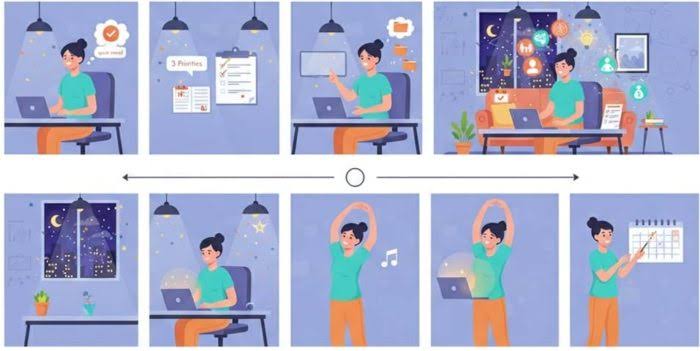
It’s 7:45 pm. You told yourself you’d stop at six. Yet here you are, laptop on your knees, answering “one quick message” while dinner goes cold.
If you work from home, this probably isn’t news to you. Without an office to walk out of, there’s no natural moment where work ends. It just sort of seeps into the evening, and your downtime gets thinner and thinner.
A daily shutdown routine is a simple fix. It’s a short set of things you do at the end of every workday so your brain gets a clear signal: we’re done here.
Why You Need One
In an office, the day ends for you. You pack your bag, say goodbye, and commute home. The commute alone gives your mind time to switch gears.
At home, nothing does that job unless you build it yourself. And when you don’t, unfinished tasks hang around in the back of your head. You replay a awkward meeting while brushing your teeth, or suddenly remember an email at 11 pm. Your body has stopped working, but your mind hasn’t.
A good shutdown routine helps with all of that:
- You sleep better because your head is quieter.
- Tomorrow starts with less scramble.
- Work and personal time stop blurring together.
- That constant “always on” feeling eases off, which matters a lot if you’re heading toward burnout.
Pick a Finish Line
Start with a time. Not a perfect one, just a realistic one. If your day usually wraps up around 5:30, make that your target and aim to hit it most days. Some days you’ll run over, and that’s normal.
Setting a reminder for about 20 minutes beforehand helps. Treat it as a “start wrapping up” alarm, not a green light to open a new task.
Look Back at Your Day
Before you shut the laptop, take two minutes to ask what actually happened. What did you finish? What moved forward? What stalled?
This is surprisingly useful, because plenty of us feel slammed all day and still can’t say what we got done. A glance at your browsing can help fill the gap. Focus Companion gives you an overview of how your time in the browser was spent, so your end-of-day review rests on what really happened instead of a vague impression. No need to grade yourself. You’re just getting a clearer picture of your day.
Get Everything Out of Your Head
Those unfinished bits are the reason your mind keeps working after hours. So write them down. A notes app is fine, and so is a paper notebook. Jot down:
- Tasks you didn’t finish
- Ideas that popped up along the way
- Replies you still owe someone
- Anything you’re worried you’ll forget
You’re not solving any of it here. You’re just parking it somewhere reliable, so your brain doesn’t have to keep holding it.
Choose Tomorrow’s Top Three
Next, pick the three things that matter most tomorrow and put them at the top of your list. Three, not ten. A huge list looks like a mountain, while three clear priorities feel manageable.
There’s a nice side effect, too. When you wake up already knowing what comes first, you skip the morning dither and don’t fall straight into your inbox.
Close Things Down, Literally
Now tidy up your digital space:
- Close extra tabs and save the ones you need
- Quit work apps, or at least mute them
- Sign out of work email on your phone if you can
- Shut the laptop, or put it out of sight
That last one matters more than you’d think. Closing the lid is a physical signal, a bit like flicking off a light switch at the end of a shift.
Finish With a Little Ritual
Many people like to end with something small and repeatable. It could be saying “that’s it for today” out loud, going for a quick walk, making tea, or changing out of your work clothes. What you pick matters less than doing it consistently. After a few weeks, your brain starts to link that ritual with switching off.
When It Doesn’t Go Smoothly
Messages keep coming in after hours. Agree on response times with your team, and use do-not-disturb so notifications don’t drag you back.
Your days are unpredictable. Keep the routine short, even just five minutes. A tiny version beats skipping it altogether.
You keep forgetting. Hook it onto something you already do, like closing your calendar or finishing your last meeting.
Keep It Simple
You don’t need all of this on day one. Begin with two things: write down your open loops, and pick tomorrow’s top three. Add the rest when it feels natural. You’ll skip it some days, and that’s okay. What counts is coming back to it.
A daily shutdown routine won’t make you work less. What it does is let you work with more focus, rest with a clearer head, and end the day feeling finished instead of behind.
